
xAI - Recommendation System Deep Dive
X published their recommendation system. Let's understand it.

Introduction
X has made public their recommendation system.
End to end.
From retrieval to ranking.
This is Machine Learning at Scale and this is the exact content I love discussing, so this required a special edition.
LFG!
Read all the way to get my take on it :)
First things first.
If you are not super familiar with Recommendation systems, I suggest you take a look at my deep dives:


Now, with that out of the way, let’s get started!
TLDR
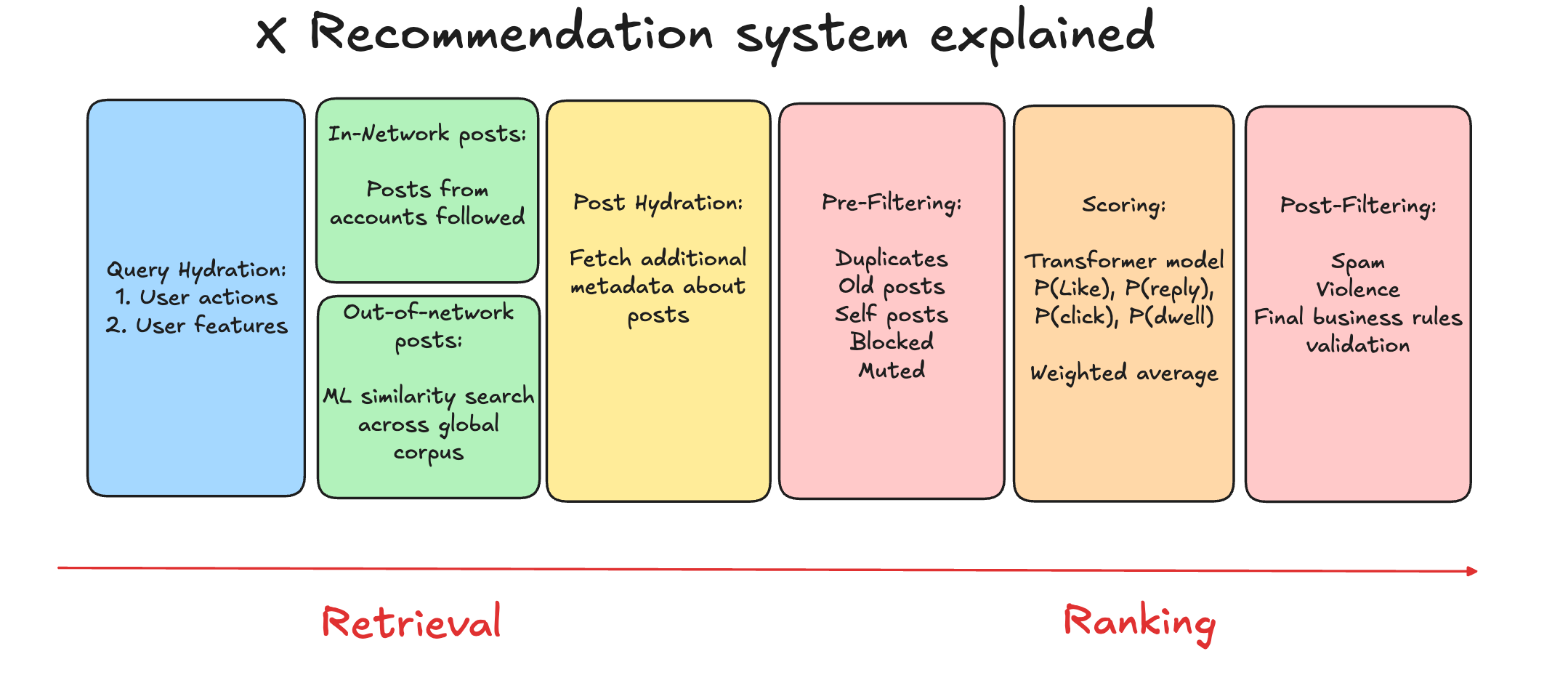
It operates on a "vector-first" philosophy. The pipeline executes a standard four-stage lifecycle: Query hydration → Retrieval → Filter → Rank
The defining characteristic of the system is the removal of explicit feature engineering in favor of raw embedding interoperability.The system does not “calculate” features; it looks up pre-computed vectors and passes them to a distilled Grok model.
Another interesting point is the lack of a prescorer, they chose to optimize for a better feed vs latency.
In the end of the newsletter, I will comment in depth based on my experience as an MLE.
Query Hydration
The recommendation request begins with the RecommendationRequest struct in Rust. This is not a simple database lookup; it is a parallelized gather-and-scatter operation to build the User Context.
The system hits the User Data Store to build a composite view of the user’s current state.
User Embedding: A dense float-vector (d=2048) representing the user’s long-term interests. This is pre-computed by a separate offline User Tower and stored in a low-latency KV store.
Real Graph State: The system retrieves the user’s weighted social graph. Unlike a standard follower list, this contains interaction coefficients, specifically identifying the “Core Network” (users with >0.8 interaction probability).
Anti-Signals: A Bloom filter or hash set of recent “Dislikes,” “Mutes,” and “Show Less” actions. This is loaded early to short-circuit retrieval paths later.
If the User Embedding fails to load, the request is terminated immediately.
The architecture treats the embedding as the primary key for the entire session.
Retrieval
The system targets a retrieval pool of roughly 1,500 to 2,000 candidates per request. This comes from two distinct, concurrent sources.
1. Source: Thunder (In-Network / Real Graph)
Thunder is the graph processing engine. It executes a breadth-first search on the user’s “Core Network.”
Mechanism: It iterates over the top users the requestor interacts with.
Time Window: It creates a window of recent posts (typically <24h, tighter for high-velocity users).
Logistic Regression Lite: The retrieved posts undergo a lightweight scoring pass (a linear combination of author_weight and time_decay) to cap the retrieval at ~1,000 candidates.
2. Source: Phoenix (Out-of-Network / Vector Search)
Phoenix is the ANN (Approximate Nearest Neighbor) engine. It solves the embedding retrieval problem.
Algorithm: It uses HNSW (Hierarchical Navigable Small World) graphs to index the vector space of all recent tweets.
Query: It queries the index using the User Embedding from the hydration step.
Optimization: The search is sharded. The index is likely segmented by language and safety clusters to prune the search space immediately. It returns the top ~1,000 candidates that act as “nearest neighbors” to the user’s interest vector.
Post Hydration
At this stage, the system has a list of ~2,000 Candidate IDs.
The system performs a massive multi-get request to the Tweet Store:
Content Embeddings: The critical payload. The system fetches the pre-computed embedding for the tweet text and any attached media (Video/Images are projected into the same latent space).
Interaction State: Real-time counters (Likes, Reposts, Replies). These are not used as raw integers but are often log-normalized and bucketed before entering the model.
Author Features: The embedding of the author is fetched to compute the dot-product similarity between User_Vector and Author_Vector as an input signal.
Filters
Before the compute-heavy ranking, the candidate list passes through a chain of boolean predicates (Filters).
Visibility Filter: Checks the bi-directional block graph. If Candidate A blocked User B (or vice versa), drop.
Safety Filter: Enforces the user’s specific sensitivity settings. It checks the content labels (e.g., label:nsfw_high_precision).
Feedback Fatigue Filter: Checks the “Anti-Signals” loaded during Query Hydration. If the user clicked “Show Less” on this author or this topic cluster within the last session, the candidate is dropped.
Social Proof Filter: In specific “For You” configurations, the system enforces a minimum engagement threshold (e.g., “Must have >5 likes”) to prevent cold-start spam from entering the heavy ranker.
Scoring
The filtered candidates are batched and sent to the Heavy Ranker. This is the most expensive component in the stack.
The model is a JAX-based Transformer (a distilled version of the Grok architecture).
It treats recommendation as a sequence modeling problem.
Input: [User_Context_Tokens] [Candidate_1_Tokens] ... [Candidate_N_Tokens]
Output: A probability distribution over a set of engagement actions (P(Like), P(Reply))
This is a Multi-Task Learning (MTL) structure, with one head for each prediction.
Personal deep dive
1. Production Ranker Size vs. Latency
The codebase hides the massive operational cost here.
Standard industry practice (Meta, TikTok) typically involves a three-step funnel:
Retrieval (10k) → Light Ranker (2k) → Ranker (500)
X has removed the middle step. They are feeding ~1,500 candidates directly into a Transformer-based ranker.
This is computationally wildly expensive. Unless they have infinite TPU budget, they are likely running a smaller, quantized model than they admit, or their “Grok” ranker is heavily distilled. Without a prescorer to cull the “obviously bad” 50% of candidates cheaply, this is expensive and most importantly high latency.
2. Transformer Heads: Standard but opaque
